
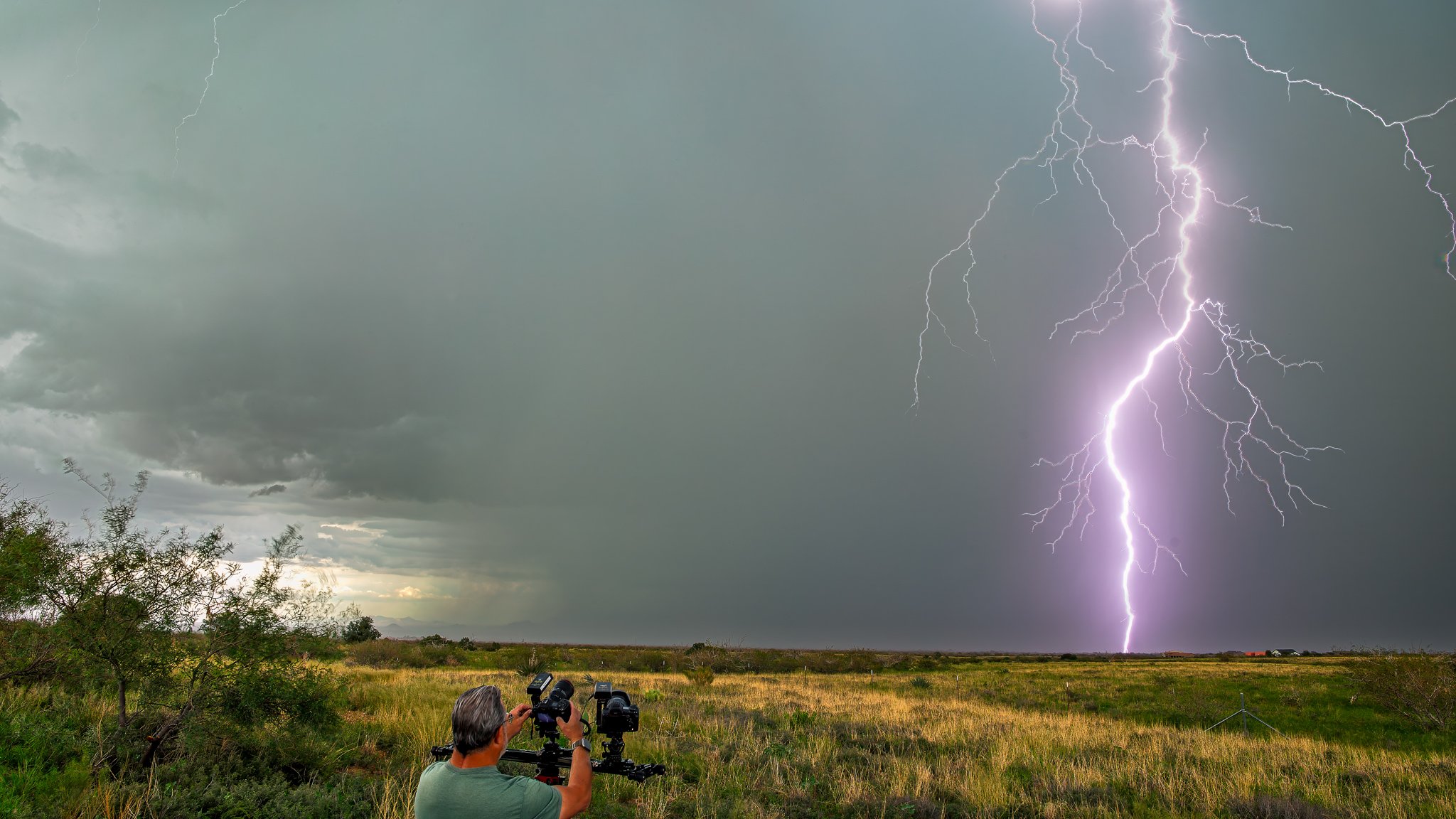
My Workshop Gear
This page outlines the core equipment I personally use and recommend during my photography workshops. Everything listed here has been field-tested under real-world conditions—storms, night skies, wildlife, and travel—and selected for reliability, performance, and durability.
Disclosure: As an Amazon Associate, I earn from qualifying purchases.
Camera Bodies
Your camera body matters less than knowing how to use it well, but reliability, weather sealing, and autofocus performance become critical in demanding environments.
Primary Camera Body
I use the Canon R5 Mark II as my primary camera during workshops. It offers excellent dynamic range, fast and reliable autofocus, strong low-light performance, and the durability needed for real field conditions.
Backup Camera Bodies
I always carry at least one backup body in the field. My current backups include the Canon R5, Canon 5D Mark IV, and Canon 5D Mark III. While older bodies may lack some modern features, they remain dependable tools and reinforce an important lesson: skill and preparation matter more than the latest model
Camera Lenses
Lens choice is driven by subject distance, available light, and working conditions. These are the focal lengths and lenses I use across storms, night photography, wildlife, and general field work.
Super-Telephoto (Wildlife / Specialized Use)
Canon EF 800mm f/5.6 — used for wildlife and long-distance subjects (no longer available new)
Canon EF 400mm f/2.8 — used for wildlife, Moon, and low-light action (no longer available new)
Canon RF 200 - 800mm f/7.1-9 — used for wildlife, the Moon, and other long distance subjects
I include the EF 800mm and EF 400mm for context because they remain part of my working kit, although they are no longer available new.
Telephoto & Mid-Range Zooms
Canon EF 70–200mm f/2.8 — distant storms, compressed landscapes, and general telephoto work
Canon EF 300mm f/4 — lightweight wildlife, Moon, and field versatility
Standard & Wide-Angle Zooms
Canon EF 24–70mm f/2.8 — my primary storm-chasing and general-purpose lens
Canon EF 16–35mm f/2.8 — close-range storms, landscapes, and environmental scenes
Primes (Storms & Night Sky)
Canon RF 50mm f/1.4 L — My primary lens for Sprites and my go-to second lens for storms. It’s lightweight, fast, and ideal when I want a tighter field of view or need extra light at dusk and night.
Rokinon 24mm f/1.4 — dedicated night-sky and Milky Way lens, chosen for its wide field of view and strong low-light performance.
Canon EF 24–70mm f/2.8 — View on Amazon
Canon EF 16–35mm f/2.8 — View on Amazon
Canon EF 70–200mm f/2.8 — View on Amazon
Canon RF 200 –800mm f/7.1-9 — View on Amazon
Canon EF 300mm f/4 — View on Amazon
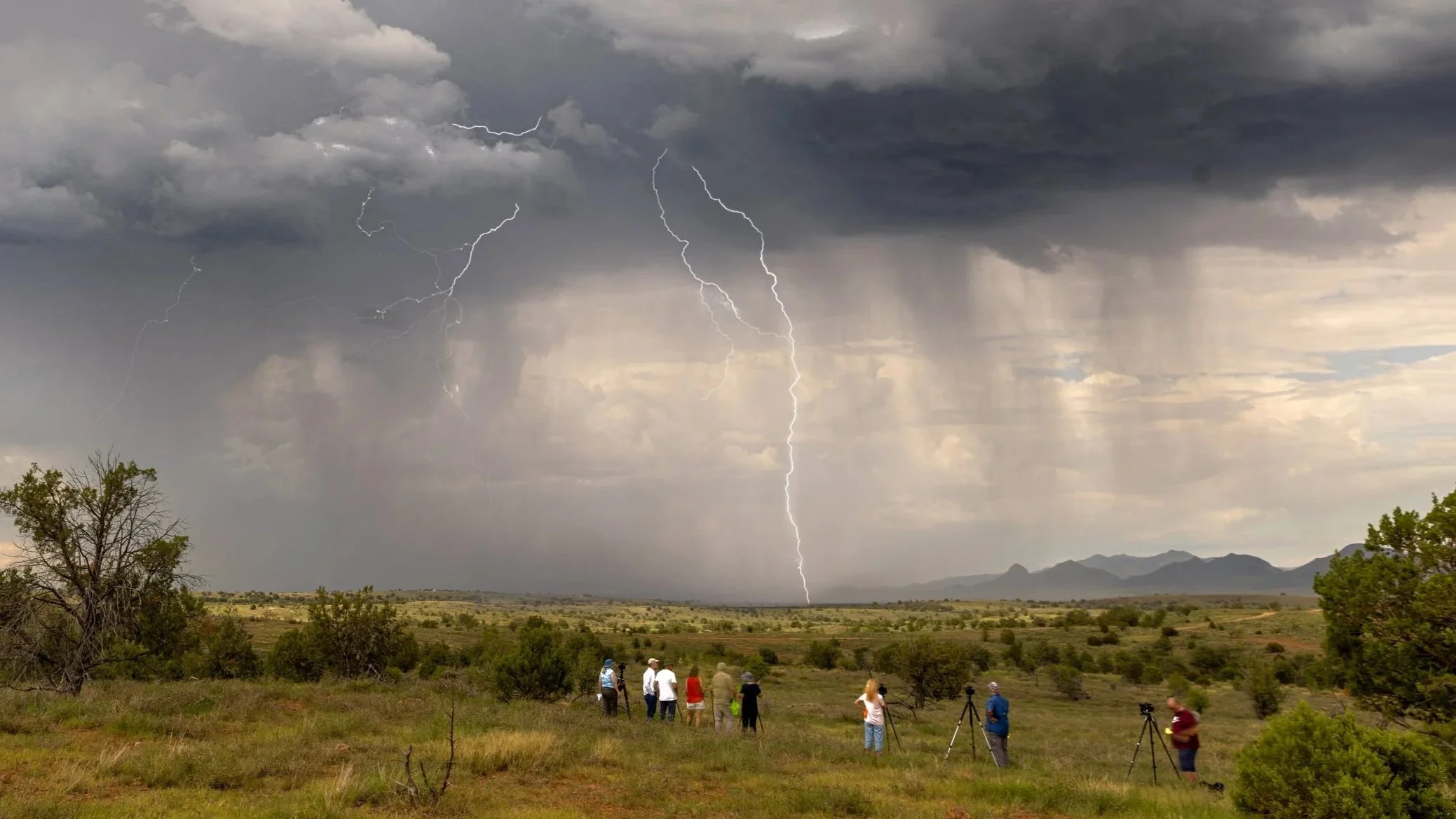
Tripods, Filters & Accessories
Tripods & Support
A solid support system is non-negotiable for long exposures, lightning photography, night skies, and wildlife. Stability matters far more than weight savings in real field conditions.
I use ProMediaGear, Acratech, and Gitzo-class support systems because they are rigid, reliable, and designed to handle wind, vibration, and heavy lenses.
ProMediaGear Tripods — Buy from ProMediaGear
Acratech Ball Heads — Buy from Acratech
Sirui AM-284S +G1 Carbon Fiber Tripod (travel or secondary support) — View on Amazon
Filters
Filters are essential tools for controlling light and solving exposure problems that can’t be fixed in post-processing—especially during daytime storm photography.
I rely heavily on Breakthrough Photography filters for optical quality, neutral color, and durability in harsh environments.
Breakthrough Photography ND Filters (3-stop) — Buy from Breakthrough Filters
Breakthrough Photography Circular Polarizers — Buy from Breakthrough Filters
Breakthrough Night Sky Filter — Buy from Breakthrough Filters
Lightning Triggers
Lightning triggers dramatically increase your chances of capturing daytime lightning by detecting a flash and automatically firing the camera. I currently use two triggers, depending on the camera and how I’m shooting. If you’re shooting lightning with your camera’s pre-capture feature, use the Motion Horizons Bolt Hunter. It’s designed to work with pre-capture so you can take advantage of the frames recorded before the shutter is triggered.
Motion Horizons Bolt Hunter
I was one of the original beta testers for the Bolt Hunter and have used it extensively in real-world storm conditions. Paired with a camera that supports pre-capture, it gives lightning photographers capabilities that simply weren’t possible with a conventional trigger-and-camera combination. The Bolt Hunter also has more advanced features for different shooting scenarios than any other trigger currently on the market.
MK Controls Lightning Bug Plus
A proven, reliable trigger that I’ve used extensively in real storm conditions for over six years. It remains an affordable, excellent option and is widely available.
Motion Horizons Bolt Hunter — Buy Direct from Motion Horizons
MK Controls Lightning Bug Plus — Buy from MK Controls - Use code RGallucci for free shipping
Camera Bags & Travel Gear
Protecting your equipment while keeping it organized and accessible is especially important when traveling and working in the field. I look for camera bags that provide excellent protection, hold up through years of travel, and give me quick access to my equipment when conditions change rapidly.
I primarily use Gura Gear and Think Tank Photo bags. These are bags that have proven themselves over time and in rough conditions, and have held up better than any others I’ve used. My choice depends on how much equipment I’m carrying and whether I’m traveling by air, working from a vehicle, or carrying gear into the field.
Gura Gear
I’m a little obsessive about intelligent design. When a company creates equipment that shows it understands how photographers actually work in the real world, it gets my attention. Gura Gear has done exactly that with the Kiboko series: intelligent access to all my equipment without turning the bag over, plus an innovative blue indicator that lets me see at a glance whether the bag is completely closed. I use these bags every day and on every workshop.
Gura Gear Kiboko 22L Camera Backpack
Buy from Gura Gear
Gura Gear Kiboko 30L Camera Backpack
Buy from Gura Gear
Think Tank Photo
When I travel by air to a workshop location or shoot, nothing replaces my Think Tank Airport Security 3.0. It fits everything I can conceivably overpack, plus more, while still fitting in the overhead bin, so I never have to worry about checking my camera gear.
The MindShift Gear BackLight 26L was the first serious camera backpack I purchased, and it has stayed with me through the years. It remains a sturdy, durable backup when I need to carry even more equipment on an extended shoot.
Think Tank Airport Security 3.0
Buy from Think Tank Photo
MindShift Gear BackLight 26L
Buy from Think Tank Photo